Hindu Wedding Dates 2027: The Complete Vivah Muhurat Calendar
In a Hindu wedding the date is not chosen after the venue - it is chosen first, and everything else is arranged around it. That order is what makes the vivah muhurat (विवाह मुहूर्त) calendar the most practically useful document a couple can have in front of them at the start of planning. It tells you which weekends of 2027 actually exist for you, and by extension which venues you are realistically competing for.
Below is the 2027 calendar of auspicious marriage muhurats (शुभ विवाह मुहूर्त 2027), month by month, with timings calculated for Jaipur rather than the Delhi default that most published lists use. Alongside each month you will find what that time of year actually means on the ground in Rajasthan - weather, competing demand on hotel rooms, and the operational constraints that decide whether a date is workable as well as auspicious.
2027 विवाह मुहूर्त - संक्षेप में
हिंदू विवाह में पहले शुभ मुहूर्त तय होता है, उसके बाद वेन्यू। 2027 में शादी की ज़्यादातर तारीखें जनवरी से जुलाई की शुरुआत तक और फिर नवंबर-दिसंबर में हैं। जुलाई के मध्य से नवंबर में देवउठनी एकादशी तक चातुर्मास के कारण विवाह नहीं होते, और दिसंबर के अंत से जनवरी के मध्य तक खरमास रहता है। जयपुर में नवंबर और फरवरी की तारीखें सबसे पहले बुक होती हैं, इसलिए दो-तीन तारीखें चुनकर वेन्यू और कमरों की उपलब्धता एक साथ जाँचें।
Why the date decides the venue, not the other way round
Every family planning a Hindu wedding in 2027 is working from broadly the same short list of dates. That is the whole difficulty. When a few dozen days in the year carry the weight of an entire wedding season, demand collapses onto them, and the properties that can hold a large Indian wedding well - the heritage palaces, the large resort lawns, the hotels with enough contiguous rooms for a three-day function - are committed far in advance on exactly those days.
The consequence is straightforward. If you have flexibility across two or three muhurat dates, you have real choice of venue. If you are locked to one date because of a family horoscope (कुंडली), your planning window needs to start earlier and your venue shortlist needs to be built around what is genuinely available rather than what you saw on a website. Neither situation is a problem. They are simply different planning problems, and knowing which one you are in changes what you should be doing this month.
There is a second reason to work date-first. A muhurat is a window of specific hours, not a day. Where that window sits inside the twenty-four hours governs your entire production schedule - when the baraat (बारात) leaves, when the mandap (मंडप) has to be ready, how many nights your guests need rooms for, and whether the ceremony falls inside or outside the hours when outdoor amplified sound is permitted. Two dates in the same month can produce completely different weddings for this reason alone.
How to read the tables
Each month below lists the auspicious dates for marriage, the muhurat window in local Jaipur time, and the tithi (तिथि) and nakshatra (नक्षत्र) governing that window. A few notes on using them.
- The window is the period within which the pheras (फेरे) should be completed, not the duration of the wedding. Your priest will identify the precise moment inside it.
- Windows frequently cross midnight. Where they do, the date shown is the date on which the window opens.
- Timings are calculated for Jaipur. Because several muhurat boundaries are anchored to local sunrise, they differ from Delhi-calculated lists by roughly three to eight minutes - enough, on a handful of dates, to move a window across a day boundary.
- This calendar follows mainstream North Indian practice. South Indian traditions calculate muhurtham differently and will produce a different set of dates; families following a specific regional or community panchang (पंचांग) should treat this as a starting point and confirm with their own priest.
- None of this replaces horoscope matching (कुंडली मिलान). A date being auspicious in general does not make it auspicious for a particular couple.
2027 Vivah Muhurat Dates: Month by Month (2027 शादी के शुभ मुहूर्त)
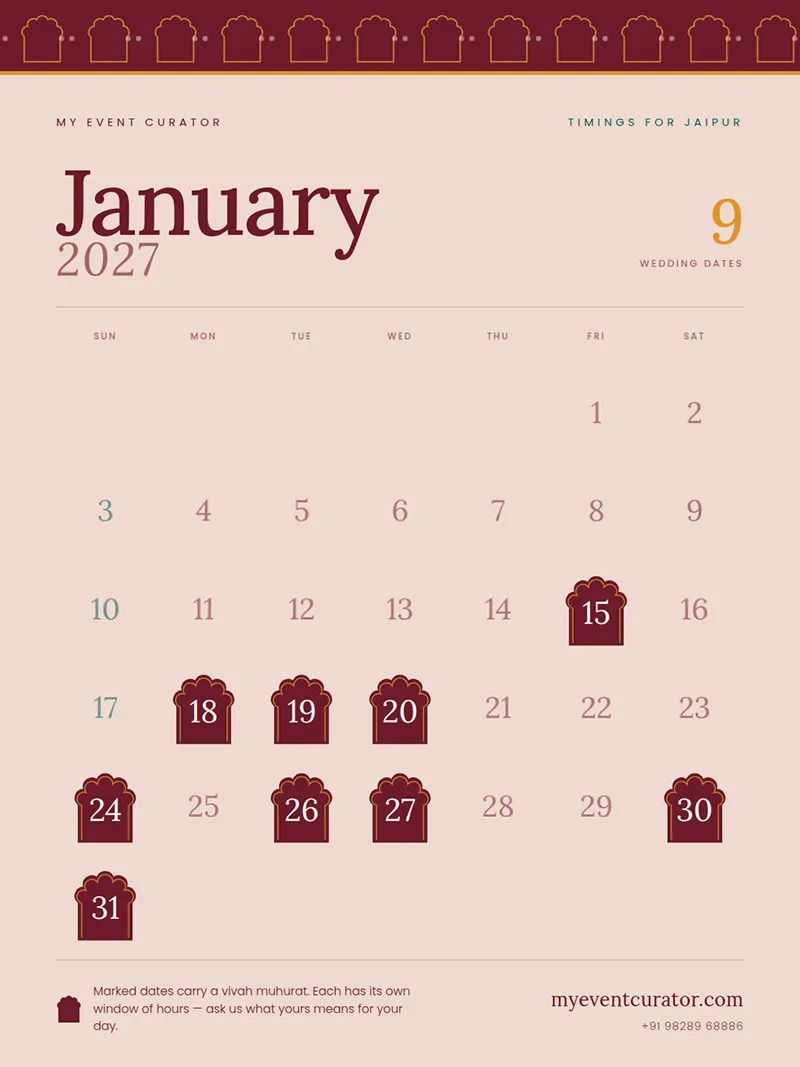
January 2027
Deep winter in Rajasthan. Mornings sit low enough that an early muhurat needs outdoor heating and a covered pheras mandap, and guests travelling in from warmer states are routinely under-dressed for a 6 AM ceremony. Evening functions work beautifully - the light after 5 PM across Jaipur's sandstone is the reason winter shoots book out first.
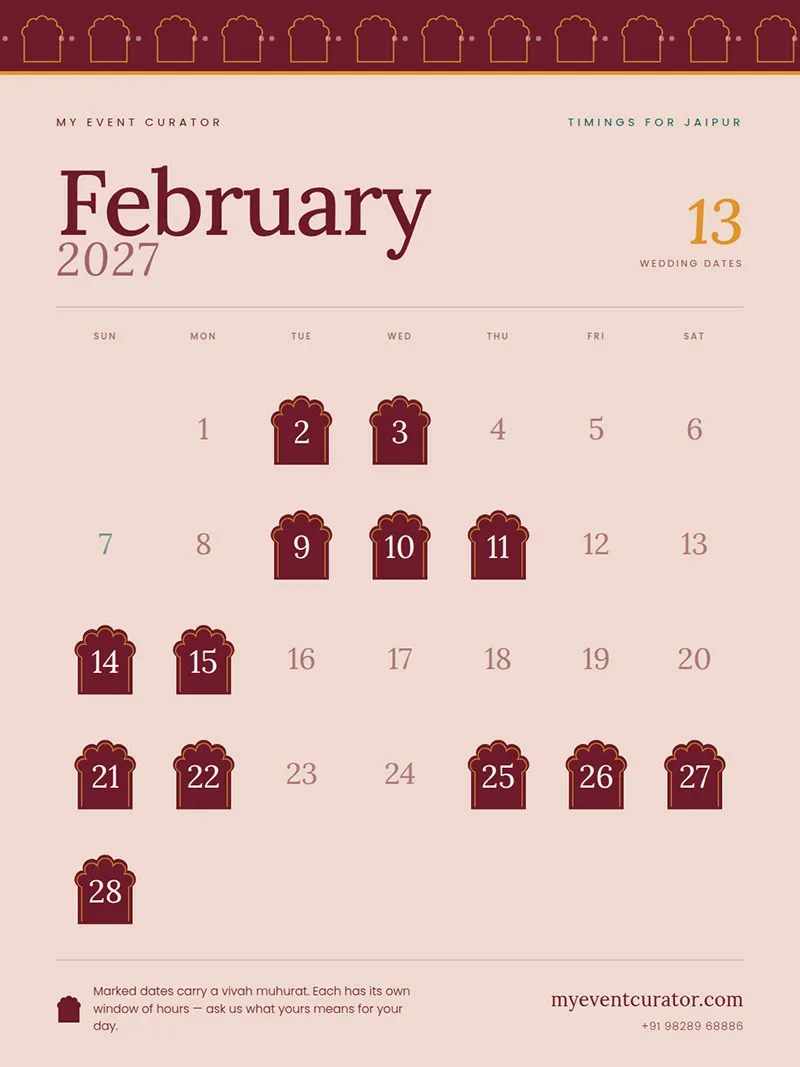
February 2027
The single strongest month for Jaipur weddings on weather alone. Daytime warmth without heat, cold-but-manageable nights, no dust. Expect the heritage palaces and the larger resort lawns to be committed the furthest ahead of any month in the year.
March 2027
Comfortable through the first half, noticeably warm by the last week. Holi falls in this window and shifts both hotel occupancy and staffing across the city for several days either side, which matters if your function schedule runs long.
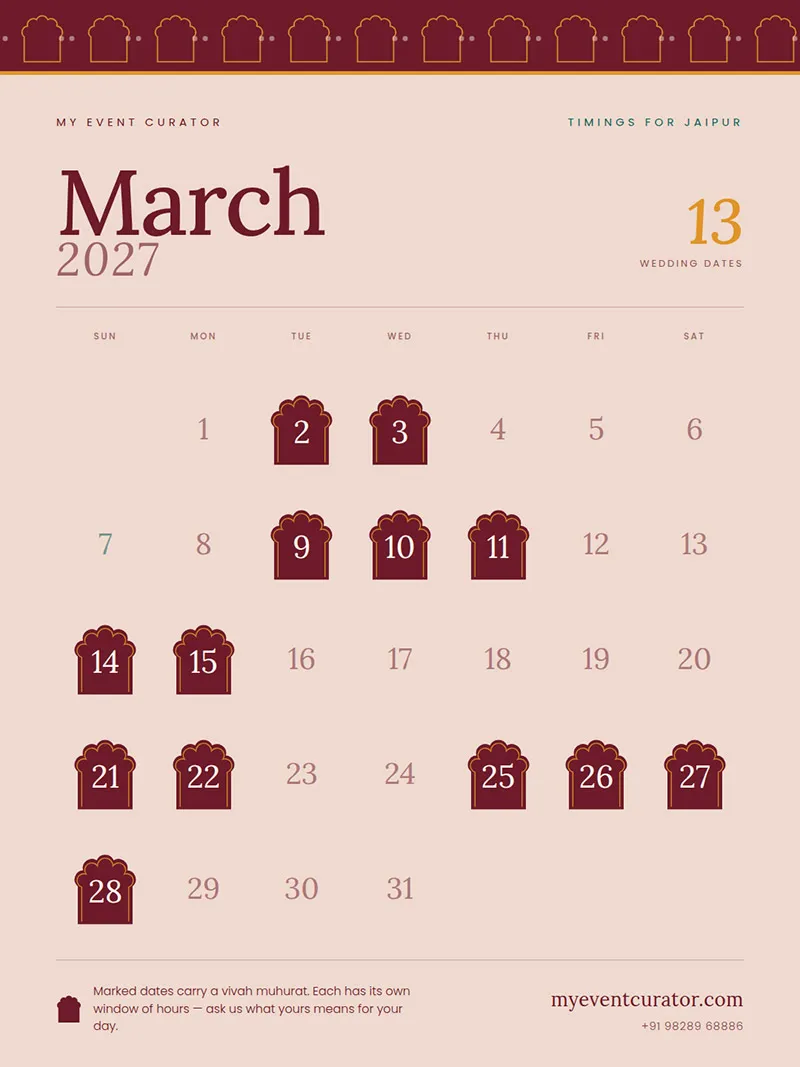
April 2027
Heat builds quickly in Rajasthan through April. Daytime outdoor functions become difficult; couples who hold an April date usually move mehendi and haldi indoors or under heavy shade and push the sangeet and pheras later into the evening.
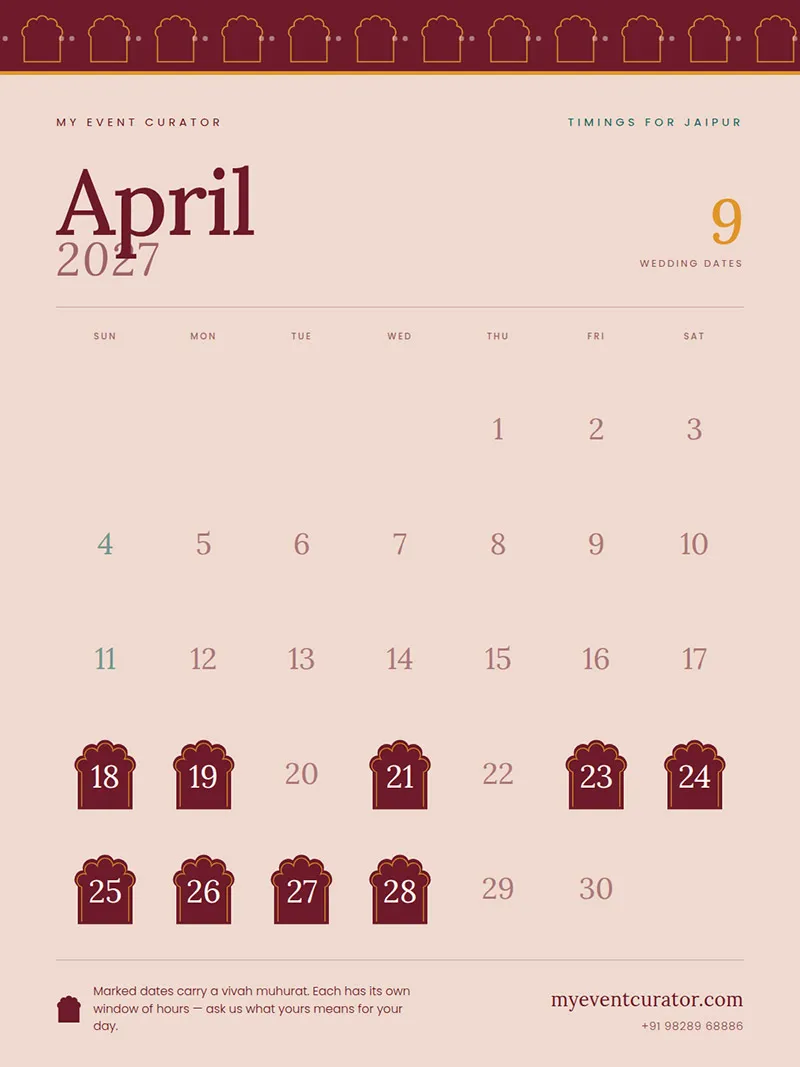
May 2027
Peak summer. Outdoor functions in Jaipur are genuinely hard in May, and most couples holding summer muhurats move the wedding to a hill destination or to a fully indoor ballroom. Venue availability is at its widest of the year in this month.
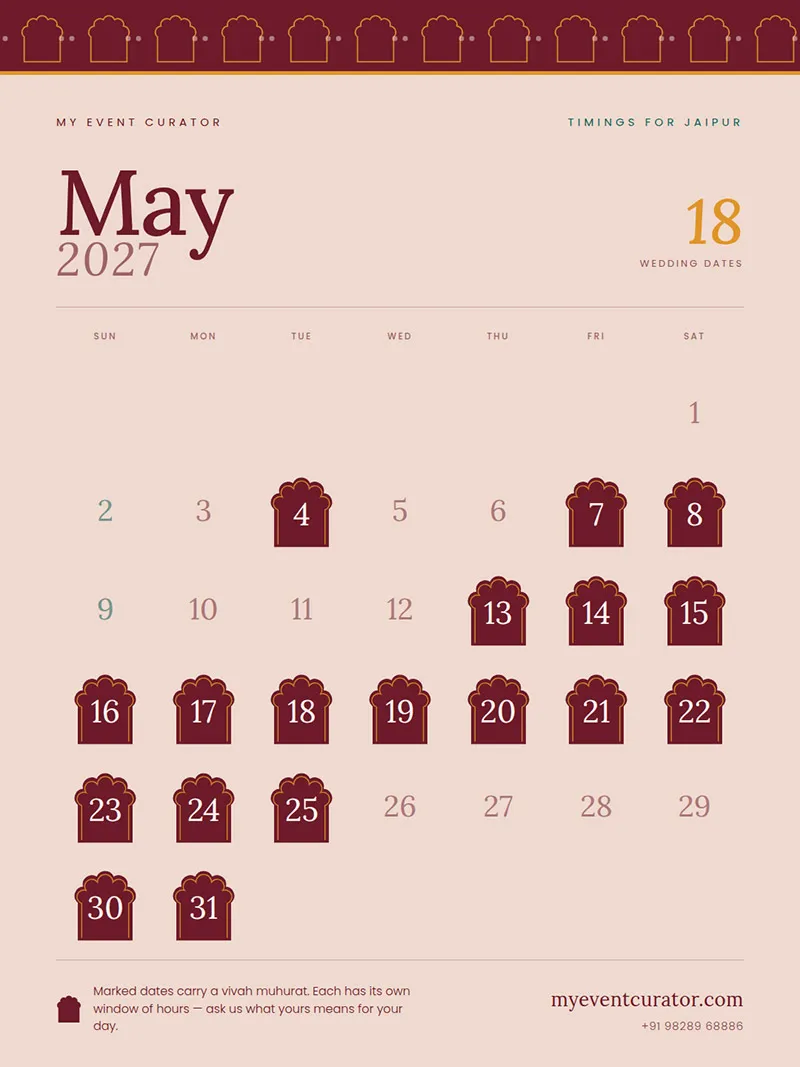
June 2027
Extreme heat until the monsoon breaks. Same considerations as May, with the added variable of the first rain arriving anywhere from the second week onward and affecting outdoor set-up decisions made weeks earlier.
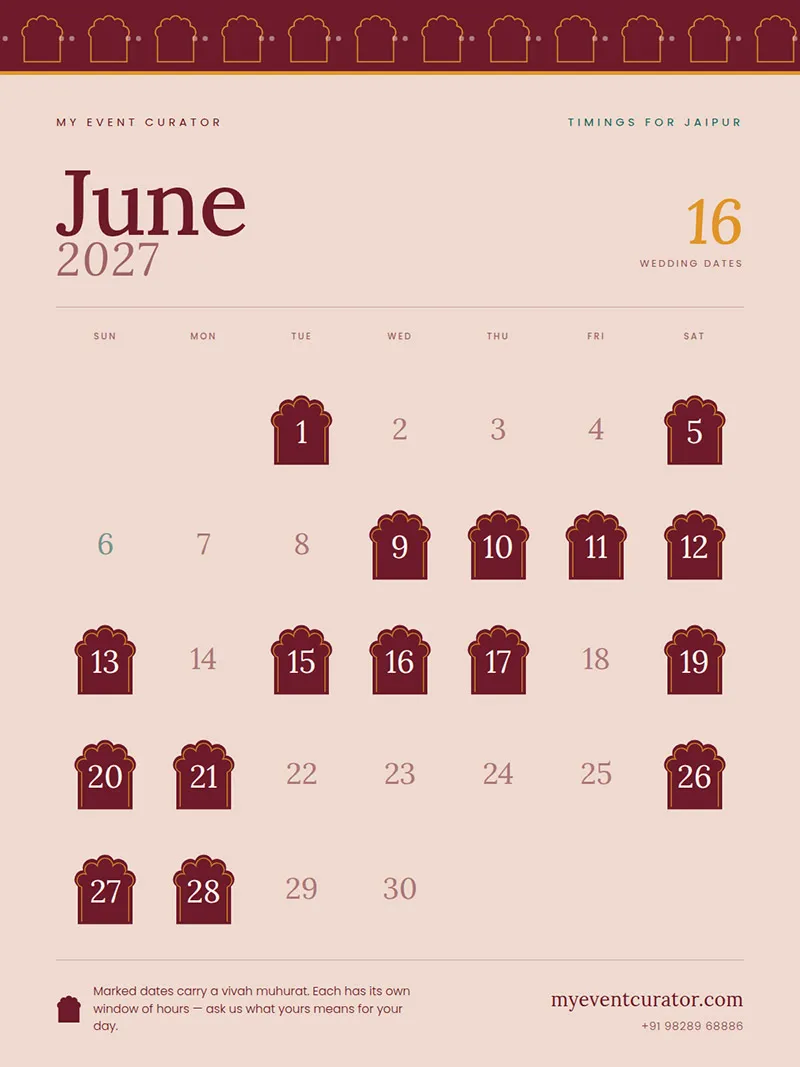
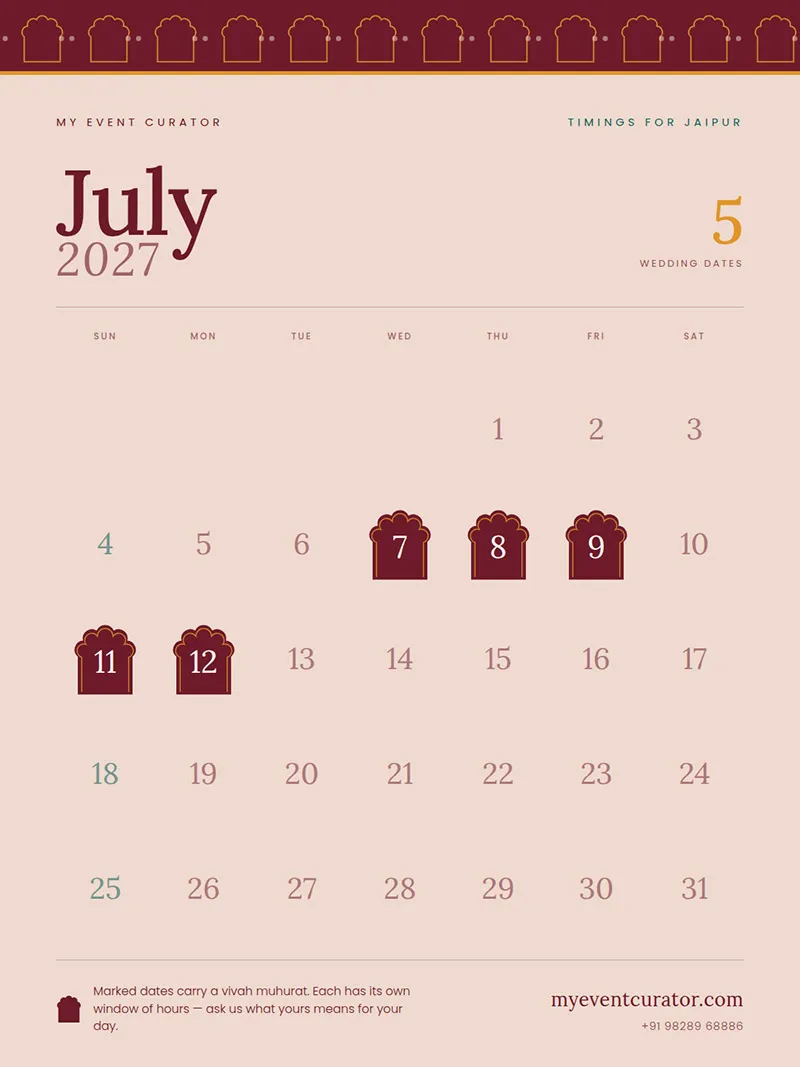
July 2027
A short run of dates in the first half of the month, then nothing. Chaturmas (चातुर्मास) begins mid-July and closes the calendar completely until November. A July wedding also means monsoon: workable indoors, but outdoor mandaps and open lawns carry real weather risk.
August 2027
Within Chaturmas. No vivah muhurats in mainstream North Indian practice. Useful month for venue recces, tastings and vendor meetings, since properties are quiet and general managers are available.
September 2027
Still within Chaturmas, and Pitru Paksha (पितृ पक्ष) typically falls in this window - a fortnight during which auspicious ceremonies are traditionally not held at all. Confirm the 2027 dates before scheduling even a pre-wedding function.
October 2027
No wedding dates. Chaturmas runs through the whole of October in 2027, so the season does not open until November. Navratri and Dussehra still fill Jaipur's hotels this month, which matters if you are planning a pre-wedding shoot or bringing family in early.
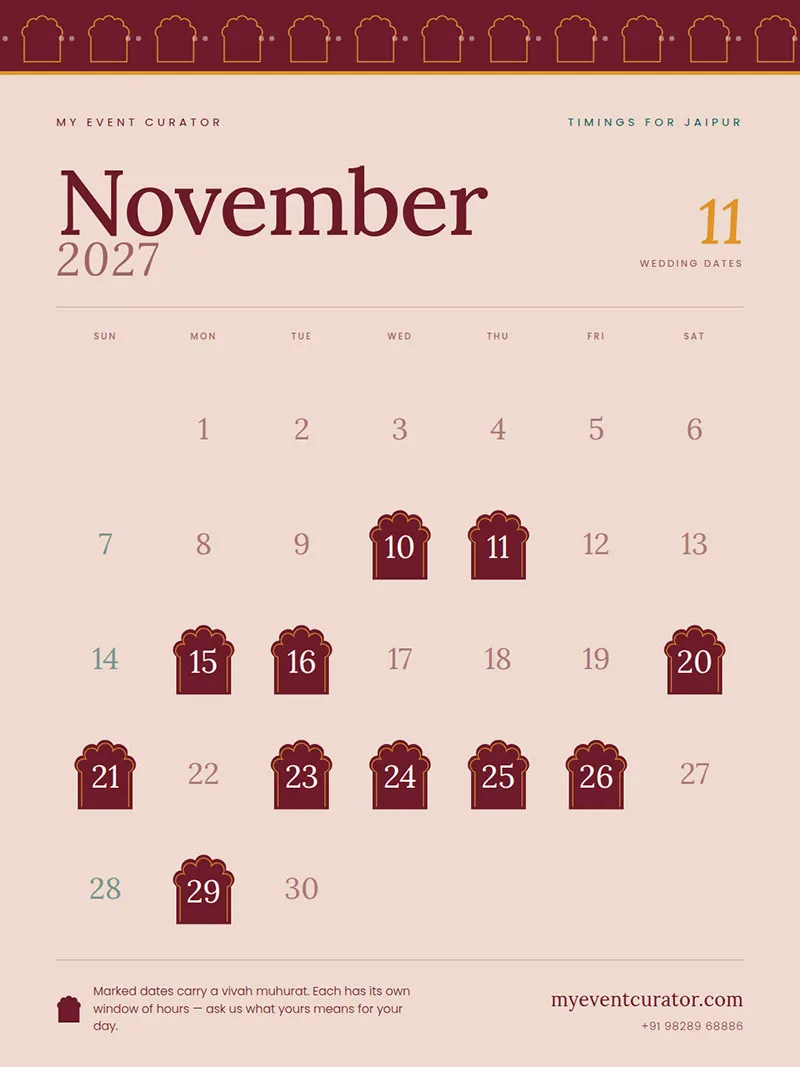
November 2027
Devuthani Ekadashi (देवउठनी एकादशी) marks the formal end of Chaturmas and releases the biggest concentration of wedding dates in the year. This is the most contested month in Jaipur - the palace properties and the larger resort lawns clear out first, often more than a year ahead.
December 2027
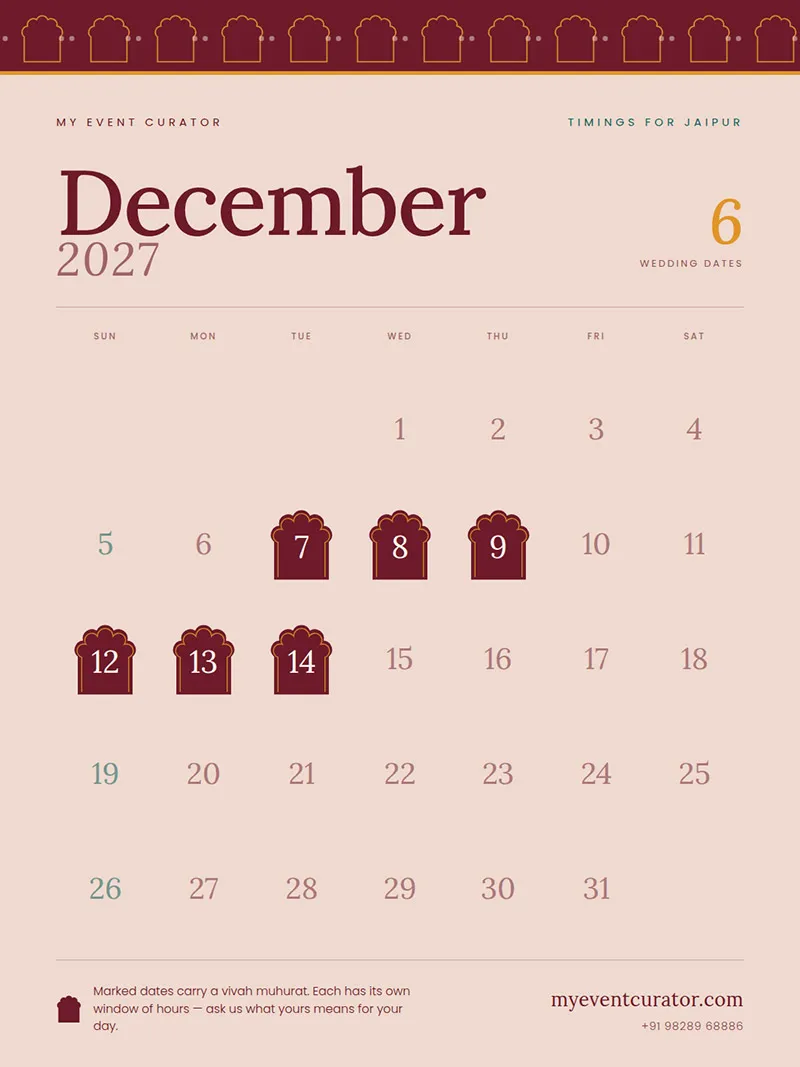
Strong dates, excellent light, cold nights. The month ends with the onset of Kharmas (खरमास), which closes the season until mid-January. December also collides with corporate offsites and the year-end leisure season, tightening room inventory across Jaipur.
The periods in 2027 with no wedding dates at all (2027 में कब नहीं होंगी शादियाँ)
Large stretches of any year carry no vivah muhurats. Understanding why helps you plan around them rather than being surprised by a four-month gap in the middle of your shortlist.
Chaturmas (चातुर्मास)
The four-month period beginning at Devshayani Ekadashi (देवशयनी एकादशी) and ending at Devuthani Ekadashi (देवउठनी एकादशी), during which weddings are traditionally not performed. It removes the entire monsoon and most of the early autumn from the calendar, and its closing date is the single most consequential day in the wedding year - the reopening of the season is why November is so heavily contested in Jaipur.
Kharmas (खरमास)
Two periods each year, when the Sun transits Sagittarius (धनु) and Pisces (मीन), during which auspicious ceremonies are set aside. The winter Kharmas closes the December season and holds until roughly mid-January; the spring one interrupts the March–April run.
Guru Asta and Shukra Asta (गुरु अस्त और शुक्र अस्त)
The combustion of Jupiter and of Venus - periods when each planet sits too close to the Sun to be visible. Both are traditionally treated as unsuitable for marriage, and because they move independently of the solar calendar, they can remove dates from months that would otherwise be full. These are also the periods most often missed by couples working from a generic online list, because many such lists ignore them entirely.
Pitru Paksha (पितृ पक्ष)
A fortnight in the autumn dedicated to ancestral rites (श्राद्ध), during which auspicious ceremonies including weddings and engagements are not held. It sits inside Chaturmas in most years, so it rarely removes dates that were available anyway, but it does affect the scheduling of pre-wedding functions and shoots.
What the peak months actually mean in Jaipur
November and February carry most of the year's weddings, and in Jaipur that has consequences beyond simply booking early.
Room inventory tightens before venue inventory does. A property may still be able to offer you a lawn on a peak date while no longer being able to offer you enough rooms in one place for a three-day function - which for a destination wedding is the constraint that actually matters. Ask about contiguous room availability across all your function nights before you fall in love with a venue, not after.
Vendor capacity is the second pinch point. On the heaviest dates of the season, the best decorators, lighting teams and photographers in the city are running multiple weddings simultaneously, and you are booking a team rather than a name. Establish early which specific people will be on your wedding.
Outdoor sound in Rajasthan is restricted after 10 PM, which on a peak-season date with a late muhurat means the sangeet has to be planned around the cut-off and the ceremony itself often runs acoustic or moves under cover. Heritage properties, several of which sit within protected precincts, can carry additional constraints on top of that. These are solvable - but they are solved at the planning stage, not on the day.
Our team has spent more than fifty years combined in luxury hospitality, and the long-standing relationships that come from that are most valuable precisely on these dates - when availability is not a matter of what a booking page shows, but of who is holding what and for how long.
Moving from a shortlisted date to a confirmed one
A practical sequence for couples working from this calendar.
- Shortlist three dates rather than one, ideally across two different months. Flexibility is the strongest negotiating position you will ever have.
- Have the horoscopes matched (कुंडली मिलान) and the shortlist cleared by your family priest before you approach any venue.
- Establish your guest count and, from it, your room requirement. This narrows the venue list faster than any other single number.
- Check availability across all three dates simultaneously rather than sequentially - sequential enquiries lose dates while you are still deciding.
- Confirm what the muhurat window means for your schedule before signing, particularly if it falls late at night.
- Hold the venue and the room block together. A venue without rooms is not a booking.
Frequently Asked Questions
How many auspicious wedding dates are there in 2027?
The count varies by panchang tradition and by the city you calculate for. The month-by-month tables above follow Drik Panchang, localised to Jaipur. Couples following a family panchang or a South Indian tradition should expect a different set - confirm with your family priest before committing to a venue.
Why do Jaipur muhurat timings differ from the ones I saw online?
Most published muhurat lists are calculated for Delhi. Sunrise and sunset in Jaipur fall a few minutes apart from Delhi, and because several muhurat boundaries are anchored to sunrise, the window can shift by roughly three to eight minutes. On a date where the window opens or closes close to midnight, that small shift can move the muhurat onto a different calendar day.
Can we get married in 2027 on a date that is not a listed muhurat?
Many families do, particularly when the couple's own horoscopes have been matched separately and a priest has cleared the date. Practically, non-muhurat dates also open up venues and vendors that are otherwise committed. Discuss it with your family priest first - this is a decision to take with religious guidance, not a scheduling shortcut.
What happens if the muhurat window falls in the middle of the night?
It is common, and it changes your whole production plan. Pheras at 2 AM means the sangeet ends earlier, the baraat moves up, guests need the following night's rooms rather than checking out that morning, and your venue contract needs to cover the overnight hours rather than a standard evening slot. Outdoor sound in Jaipur is also restricted after 10 PM, so a late muhurat usually means the ceremony itself runs acoustic or moves under cover.
How far ahead should we book a Jaipur venue for a 2027 date?
For a November or February date at a heritage palace or a large resort lawn, twelve to eighteen months is normal and the strongest dates go earlier still. For an off-peak month, a few months is often enough. If you are reading this with a 2027 date in mind, the peak-season properties are already being held.
अक्सर पूछे जाने वाले सवाल (हिंदी में)
2027 में शादी के शुभ मुहूर्त कब हैं?
2027 में विवाह मुहूर्त मुख्य रूप से जनवरी से जुलाई की शुरुआत तक और फिर नवंबर-दिसंबर में हैं। अगस्त, सितंबर और अक्टूबर में चातुर्मास के कारण शादी के मुहूर्त नहीं हैं। ऊपर दी गई महीनेवार सूची जयपुर के समय के अनुसार है। अंतिम तारीख तय करने से पहले अपने पंडित जी से कुंडली मिलान और तारीख की पुष्टि ज़रूर करवाएँ।
2027 में शादियाँ कब नहीं होंगी?
देवशयनी एकादशी से देवउठनी एकादशी तक (लगभग जुलाई के मध्य से नवंबर तक) चातुर्मास रहता है, जिसमें विवाह नहीं होते। इसके अलावा खरमास (दिसंबर के अंत से जनवरी के मध्य तक और मार्च-अप्रैल में), गुरु अस्त, शुक्र अस्त और पितृ पक्ष में भी शादी के मुहूर्त नहीं होते।
जयपुर के मुहूर्त का समय ऑनलाइन लिस्ट से अलग क्यों होता है?
ज़्यादातर ऑनलाइन मुहूर्त लिस्ट दिल्ली के सूर्योदय के अनुसार बनती हैं। जयपुर का सूर्योदय कुछ मिनट अलग होता है, इसलिए मुहूर्त का समय लगभग तीन से आठ मिनट तक बदल सकता है। आधी रात के आसपास वाले मुहूर्त में यह छोटा अंतर तारीख भी बदल सकता है।
जयपुर में 2027 की शादी के लिए वेन्यू कितने पहले बुक करें?
नवंबर या फरवरी की तारीख के लिए हेरिटेज पैलेस या बड़े रिज़ॉर्ट लॉन आमतौर पर 12 से 18 महीने पहले बुक होते हैं। कम भीड़ वाले महीनों में कुछ महीने पहले भी वेन्यू मिल जाता है। वेन्यू के साथ मेहमानों के कमरे भी एक साथ होल्ड करें।
रात में देर से मुहूर्त हो तो क्या ध्यान रखें?
राजस्थान में रात 10 बजे के बाद खुले में तेज़ आवाज़ (लाउड म्यूज़िक) पर रोक है। इसलिए संगीत पहले खत्म करना पड़ता है, बारात का समय पहले रखना होता है और फेरे अक्सर बिना साउंड सिस्टम या ढके हुए मंडप में होते हैं। मेहमानों को अगली रात का कमरा भी चाहिए हो सकता है, इसलिए यह बात वेन्यू कॉन्ट्रैक्ट में पहले से तय करें।
Planning a 2027 wedding
My Event Curator plans destination weddings across Jaipur, Udaipur, Jodhpur, Jaisalmer, Ranthambore, Pushkar, Goa, Bangalore and Abu Dhabi. If you have a 2027 muhurat date in mind, or a shortlist of two or three, we can tell you what is genuinely available on them and what each option would mean for your guest experience.
2027 की शादी के लिए तारीख तय कर ली है? अपनी तारीख और मेहमानों की अनुमानित संख्या बताइए - हम उस दिन उपलब्ध वेन्यू और कमरों की जानकारी देंगे।
Related reading: Destination Wedding Planning · Hotel & Venue Booking · Wedding Venues in Jaipur · Wedding Venues in Udaipur · Vivah Muhurat Calendar 2028
Have a 2027 date in mind? Tell us the date and your approximate guest count, and we will come back with what is available.
Quick Enquiry on WhatsApp Know More
हिंदी में WhatsApp पर पूछें
Call +91 98289 68886 or email contact@myeventcurator.com